

If you’re ready to ditch public charging queues and cut your EV running costs, installing a home wallbox is often the smartest move. With UK grants still helping eligible households, new permitted development and planning changes easing installs, and smart tariffs slashing overnight rates, 2026 is arguably the best time to get set up. In this comprehensive guide, I’ll walk you through the home EV charger grant UK, the latest installation rules, and my top 5 smart wallboxes all in plain, practical English.
We’ll cover how the OZEV grant works (including who can claim up to £350), what the smart charge point regulations demand from new devices, and how the 2025 planning changes mean far less red tape for most installs. I’ll also compare five popular 7kW home chargers side by side, including prices, dimensions, key specs, and links. And yes, we’ll discuss smart charging tariffs , such as Intelligent Octopus Go, so your EV charges when electricity is cheapest.
UK Grants & Rules in a Nutshell
OZEV home EV charger grant (up to £350)
The UK government’s EV chargepoint grant can still reduce the total cost of a home charger and installation by up to £350 (or 75%, whichever is lower). Eligibility focuses on renters and flat owners with off‑street parking; standard freehold homeowners are generally not eligible under current rules. The programme applies across several schemes—household, landlord, workplace—and runs via approved installers who submit claims on your behalf. Always check the latest eligibility on GOV.UK before you buy.
Key points:
- Amount: up to £350 per socket (capped at 75% of the total).
- Who qualifies: renters and flat owners with off‑street parking, plus landlords and workplaces via separate schemes.
- Process: choose an OZEV‑authorised installer; they submit the claim after installation.
Planning permission: streamlined (May 2025 onwards)
From May 29, 2025, the UK Government streamlined permitted development rights for EV infrastructure, removing the need for planning permission in most installations and notably speeding up delivery for residential and commercial sites. For homeowners, this typically means less paperwork and faster installations—although site-specific constraints may still apply.
Context & updates:
- Government communications and press reported the removal of planning permission for most installations to accelerate rollout; a subsequent DfT consultation (Nov 2025) considers further permitted development adjustments (e.g., cross‑pavement solutions). Always check your council’s local guidance if your property is unusual or near public highways. [gov.uk]
Smart charge point regulations (from June 2022)
All new private (home/workplace) charge points sold in Great Britain must meet smart functionality and device‑level requirements, including off‑peak default schedules, randomised delay, cybersecurity features, and visible customer information. These rules maintain grid stability while allowing you to benefit from lower overnight electricity rates.
A few highlights:
- Default off‑peak schedule built into the charger.
- Randomised delay up to 10 minutes at the start/end of a charge window to avoid grid surges.
- Security and update standards are enforced by OPSS.
BS 7671 (IET Wiring Regulations) Section 722
UK installations must comply with BS 7671, Section 722 (EV charging). Amendment 1 (2020) introduced practical measures, such as protection against a broken PEN conductor, and clarified RCD/earthing arrangements. Many modern chargers include built-in PEN fault protection, which can simplify installations (often eliminating the need for a separate earth rod). Your electrician will design the circuit to DNO notification thresholds and local supply conditions.
Smart Tariffs & Real Savings


Smart EV tariffs such as Intelligent Octopus Go automatically schedule your charging for the cheapest, greenest hours, typically giving you at least six hours of low overnight rates (with bonus cheap slots at times of high renewable generation). You’ll need a smart meter and a compatible EV or charger; the app handles scheduling so your car is ready when you specify. Rates vary by region and time, but the structure is designed to substantially reduce home-charging costs compared to standard tariffs.
📤 Intelligent Octopus Scheme Overview + Introduction
Expert Kingdom Octopus Electric Vehicles Partnership.
Expert Kingdom is proud to recommend the 100% electric vehicle salary sacrifice scheme from Octopus Electric Vehicles.
What is the Octopus Electric Vehicles salary sacrifice scheme?
A salary sacrifice car scheme is an employee benefit that lets your team access a range of electric vehicles at no upfront cost.
Octopus EV salary sacrifice car scheme offers a number of tax and personal benefits savings for the employee who pays for their electric vehicle from their gross salary before tax.
Your team can save up to 40% on the monthly cost of a brand-new EV, while boosting your sustainability credentials with zero set up cost for your business. Plus, it’s open to companies of all shapes and sizes.
You and your team get everything you need to hit the road from Octopus Electric Vehicles: car, charger, energy. The lot.
Want to find out more? Click here to register your interest
Employer Focus + Benefits:
How does it work?
You, as a business, sign up to the scheme to provide it as an employee benefit to your team. Your team pays for a brand new EV from their gross salary, helping them save on National Insurance and Income Tax. As a business, you recover some **of the cost through the employee’s gross pay.
Why is Octopus EV salary sacrifice great for your company?
- Hit your net zero targets and show both your team and your customers that you care about fighting climate change. On average, a business saves 8.2 tonnes per year with EV salary sacrifice.
- It boosts your benefits package. 75% of employees say that they’re more likely to stay at their work because of their benefits package.
- Pay less National Insurance. Your business saves on National Insurance, which many opt to put back into the scheme.
- Minimal risk with built-in early-termination protection for unforeseen circumstances.
- Your team gets the complete EV package. The car, charger, energy, insurance (subject to eligibility), servicing, maintenance, breakdown and tyres. The lot.
- That includes a free home charger with standard installation, plus 4,000 miles of free home charging.
- No off-street parking? No problem. You can get 4,000 free miles of credit on Octopus Electroverse. Check out the full T&Cs for these charging offers here.
- Bespoke Events for your team. Octopus EV organises bespoke events to help your team experience the world of EVs and give you everything you need to promote the scheme.
- 4.8 stars on Trustpilot. Octopus EV are rated as excellent for always giving impartial EV advice and dedication to customer care.
Want to find out more? Click here to register your interest
Employee Focus + Benefits:
How does it work?
You get to drive a brand-new EV as a benefit from your employer, through one easy monthly payment. You pay for your new EV from your gross salary, saving you money on National Insurance and Income Tax.
What makes Octopus EV salary sacrifice great for the employee?
- Get the whole EV package
- In one simple monthly payment, you get access to a brand new EV, access to great charging offers, insurance (subject to eligibility), breakdown cover, maintenance and servicing and tyre replacement
- Ordering is hassle free
- The Octopus EV team is on hand to help you pick the perfect EV. They’re rated 4.8 on Trustpilot, so you’re in safe hands
- No upfront deposit required
- Plus no hidden surprises or fees. Everything you need is covered in one monthly payment for peace of mind.
- Cut your carbon emissions
- Drivers can save up to 2.7 tonnes of carbon per year vs. a petrol car
- Living with an EV is cheaper than a petrol or diesel car
- Over a quarter of Octopus Electric Vehicles’s drivers said they save £150 a month on fuel costs compared to their last petrol or diesel car
Want to find out more? Click here to register your interest
Top 5 EV Charger Models
Selection criteria: Widely‑sold 7.4 kW single‑phase home wallboxes, smart‑enabled, strong UK support. If you prefer solar‑optimised models with an ecosystem (e.g., myenergi zappi), see Model 3 below.
Wallbox Pulsar Max (7.4 kW, tethered/socket options)
The Wallbox Pulsar Max is the successor to the Pulsar Plus, designed for home EV charging with smart features, including Wi‑Fi/Bluetooth, robust app control and improved durability. It supports single-phase (7.4 kW) and three-phase (up to 22 kW) setups, making it future-proof for most households. It’s available in tethered (fixed cable) and socket (untethered) versions.
Usage Experience & Performance
- Charging Speed:
At 7.4 kW, expect ~30–35 km of range per hour for most EVs. Performance is consistent and reliable, with dynamic load management to prevent overloads. - Smart Features:
Controlled via the myWallbox app (Wi-Fi/Bluetooth), allowing:- Remote start/stop
- Scheduling for off-peak tariffs
- Energy consumption monitoring
- Lock/unlock for security
Voice control via Alexa/Google Assistant is supported.
- Solar Integration:
Compatible with solar charging when paired with a Wallbox power meter. Great for eco-conscious users, but requires extra hardware. - Reliability:
Generally solid, but rarely firmware glitches and error codes (e.g., 109, 110) and limited spare parts availability.
Tethered vs Socket Options
- Tethered (Fixed Cable):
- Pros: Plug-and-go convenience; no need to carry a cable; ideal for private driveways.
- Cons: Less flexible if you change EV type; cable length fixed (5m standard, 7m optional).
- Socket (Untethered):
- Pros: Works with Type 1 & Type 2 EVs; flexible for shared spaces; cable can be locked or removed.
- Cons: Requires you to carry your own cable; slightly less convenient for daily use.

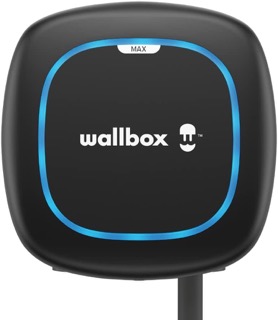
7.4 kW single‑phase: overnight full charges for typical EVs; ideal for UK domestic supply.
Wi‑Fi & Bluetooth: reliable connectivity for scheduling, updates, and energy stats.
OCPP & app control: Open Protocol Support; manage sessions and costs easily.
Earthing protection: simplifies compliance with Section 722 installs.
Tethered or socket versions, available in multiple colours: fit your parking habits and aesthetic.
Wallbox Pulsar Max EV Charger Verdict
For most UK households wanting reliable smart charging without fuss, Pulsar Max is an excellent all‑rounder at a fair price. Pair with a smart EV tariff to maximise savings.
Hypervolt Home 3 Pro Smart EV Car Charger (7.4 kW, tethered)
The Hypervolt Home 3 Pro is a premium tethered smart EV charger designed for home use. It offers 7.4 kW single-phase charging, advanced smart features, and solar integration. Built in the UK, it combines sleek aesthetics with robust durability and eco-conscious design.
Usage Experience & Performance
- Charging Speed:
Delivers up to 7.4 kW, adding roughly 30–35 km of range per hour, suitable for overnight charging. - Smart Features:
Controlled via the Hypervolt app (Wi-Fi/Bluetooth), offering:- Scheduling for off-peak tariffs
- Energy monitoring and cost tracking
- Solar charging modes (Boost, Eco, Super Eco)
- LED customization and lock/unlock security
Integration with smart tariffs like Octopus Intelligent Go and OVO Charge Anytime for cheaper rates.
- Solar Integration:
Fully supports solar charging with dynamic load management and CT clamp setup. Modes include:- Super Eco (solar-only)
- Eco (solar priority with grid backup)
- Boost (full 7 kW from any source)
- Reliability:
Rated highly for build quality and weather resistance (IP66, IK10). Users report stable performance and a polished app experience. Occasional minor app connectivity issues noted, but overall reliability is strong.
Tethered Design
Unlike Wallbox Pulsar Max, the Hypervolt Home 3 Pro is only available as tethered:
- Pros:
- Always ready to plug in; neat cable storage built into the unit.
- Multiple cable lengths (5m standard, 7.5m, 10m optional).
- Cons:
- Less flexible if you switch to a different connector type (though Type 1 and Type 2 options are available).

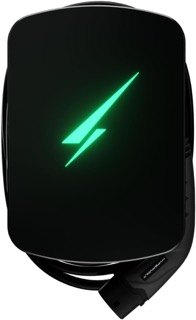
7.4 kW, Type 2 tethered, 5–10 m cable lengths.
App scheduling (Boost/Eco/Super Eco) and energy monitoring; integrates with smart tariffs.
IP66 weatherproof; IK10 impact resistance for UK outdoors.
Designed & assembled in the UK; strong support community.
Hypervolt Home 3 Pro Verdict
If you want smart scheduling, solar‑aware modes, and polished UK support, Hypervolt is a crowd‑pleaser at the premium mid‑range price.
Myenergi zappi EV Charger (7 kW, tethered or untethered)
The myenergi Zappi is a smart EV charger designed for homes and businesses, with a strong focus on integrating renewable energy. It supports single-phase (7 kW) and three-phase (up to 22 kW) setups, and is available in tethered (Type 2 cable) or untethered (socket) versions. It’s one of the most popular solar-compatible chargers in the UK and globally.
User Experience & Performance
- Charging Speed:
The single-phase model delivers up to 7 kW, adding ~30–35 km of range per hour. Three-phase models can reach 22 kW, though most EVs cap at 11 kW. - Smart Features:
Controlled via the myenergi app, offering:- Scheduling for off-peak tariffs
- Energy monitoring and real-time usage tracking
- Charging modes: Fast, Eco, and Eco+
- Integration with smart tariffs (e.g., Octopus Energy)
The app is generally rated highly for usability and flexibility.
- Solar Integration:
Zappi’s standout feature is its ability to prioritize surplus solar or wind energy:- Eco Mode: Mix of solar + grid power
- Eco+ Mode: Pauses charging if surplus solar drops below 1.4 kW
- Fast Mode: Full power from grid + renewables
This makes Zappi ideal for homes with PV systems, reducing reliance on grid electricity.
- Reliability:
Build quality is robust (IP65 weatherproof, tamper detection, PEN fault protection). Earlier versions had occasional reliability issues, but the latest models (v2.1 and GLO) include Wi-Fi, Ethernet, and firmware updates for stability.
Tethered vs Untethered Options
- Tethered:
- Pros: Always ready to plug in; includes 6.5 m cable; neat cable storage built into unit.
- Cons: Less flexible if you switch EV connector type.
- Untethered:
- Pros: Works with any Type 2 cable; ideal for multi-EV households.
- Cons: Requires you to carry your own cable, making it slightly less convenient on a daily basis.

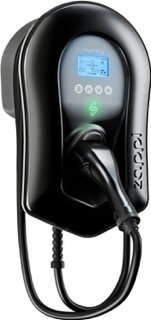
7 kW (single‑phase) with ECO/ECO+ smart PV modes.
App control, Wi‑Fi/Bluetooth; PEN fault protection built in.
Tethered & socketed variants; black or white; “GLO” compact style.
Myenergi Zappi EV Charger Verdict
If you have or plan solar PV, zappi makes the best home EV charger UK shortlist on sustainability and long‑term value.
EVEC VEC01 EV charger (7.4 kW, untethered—value pick)
The evec VEC01 is a budget-friendly smart EV charger designed for home use. It offers single-phase charging up to 7.4 kW, making it suitable for overnight charging. As an untethered unit, it uses a Type 2 socket, allowing flexibility for both Type 1 and Type 2 EVs when paired with the correct cable. It’s marketed as an affordable yet reliable solution for homeowners seeking smart charging without premium pricing.
Usage Experience & Performance
- Charging Speed:
Provides up to 7.4 kW, adding ~25–30 km of range per hour. Adjustable power settings (3.7 kW or 7.4 kW) allow compatibility with home electrical limits. - Smart Features:
Controlled via the evec app, offering:- Scheduling for off-peak tariffs
- Remote monitoring and status alerts
- Load balancing , when paired with a smart meter
OCPP 1.6J compliance ensures integration with third-party platforms. However, user reviews note that the app is basic and sometimes unreliable for logging charging history.
- Solar Integration:
Limited—does not support solar charging modes natively. This makes it less ideal for homes with PV systems compared to Zappi or Hypervolt. - Reliability:
Build quality is solid (IP55 weatherproof, corrosion-resistant, fire-retardant). Most users report stable performance, but some mention app connectivity issues and occasional firmware quirks. Customer support is generally responsive.
Untethered Design
- Pros:
- Works with any Type 2 cable (flexible for multi-EV households).
- Cleaner look without a fixed cable.
- Cons:
- Requires you to carry your own cable.
- Slightly less convenient for daily use compared to tethered chargers.

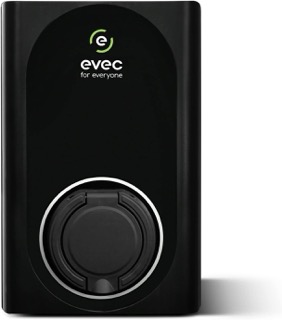
Adjustable Power: 3.7–7.4 kW output.
Universal Compatibility: Works with Type 1 & Type 2 EVs.
Weatherproof: IP55, operates from -25°C to 50°C.
Smart App: Remote control, scheduling, usage tracking.
Safety: Built-in PEN protection.
Smart Charging: OCPP 1.6J compliant for optimized schedules.
Certified: CE & UKCA approved.
Warranty: 3-year manufacturer’s coverage.
EVEC VEC01 EV Charger Verdict
If price and tidiness are the top priorities, VEC01 is a solid starter wallbox—especially for smaller driveways.
Masterplug Smart EV Home Wall Charger (7.4 kW, tethered)
The Masterplug Smart EV Home Wall Charger is a UK-designed Mode 3 smart charger offering 7.4 kW single-phase charging with a 5m tethered Type 2 cable. It’s aimed at homeowners seeking a cost-effective, solar-ready, and app-controlled solution. Built for durability, it features advanced safety features, including PEN fault protection and integrated RCDs, making installation simpler and ensuring compliance with UK regulations.
User Experience & Performance
- Charging Speed:
Delivers up to 7.4 kW (32A), adding ~30 miles of range per hour—ideal for overnight charging. - Smart Features:
Managed via the Sync Energy App or Monta App, offering:- Scheduling for off-peak tariffs
- Remote monitoring and cost tracking
- Access to 300,000+ public chargers via Monta
- SolarCharge integration for surplus solar energy
The app experience is generally positive, although some users report occasional Wi-Fi dropouts, which are often resolved with the use of extenders.
- Solar Integration:
Supports solar charging when paired with the included CT clamp, allowing for eco-friendly charging without additional subscription costs. - Reliability:
Build quality is robust (IP55 weatherproof, IK08 impact rating, UV-stabilised casing). Most users report stable performance, though customer service and warranty registration have mixed reviews.
Tethered Design
- Pros:
- Plug-and-go convenience with fixed 5m cable.
- Integrated cable management for neat storage.
- Cons:
- No flexibility for Type 1 EVs without adapters.
- Fixed cable length may not be suitable for all parking setups.


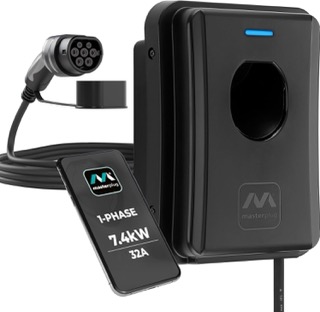
Power Output: Up to 7.4 kW (32A) single-phase fast charging.
Tethered Design: 5m Type 2 cable with LED indicator.
Smart Control: Full app integration via Monta (Wi-Fi, LAN, Bluetooth).
Solar Ready: Integrated solar function for surplus energy use.
Weatherproof: IP55 rating, operates from -20°C to +55°C.
Safety: Overload, short-circuit, and overheating protection.
Compliance: Meets UK Smart Charge Point Regulations.
Warranty: 3-year manufacturer’s coverage.
Masterplug Smart EV Charger Verdict
If you want a straightforward tethered unit with app control and a lower price tag, Masterplug is worth a look.
EV Chargers Comparasion Table
Conclusion & Buying Advice
If you want affordable smart charging, go for Ohme Home Pro. For solar integration, choose MyEnergi Zappi. If design matters, Andersen A2 is unmatched. Always check OZEV eligibility before purchase to save £350.
FAQs
How much does it cost to install a home EV charger in the UK?
Typically £500–£1,000 including labour.
Can I get an OZEV grant if I own a house?
Only flats and rentals qualify in 2026.
Do all chargers support solar integration?
No—MyEnergi Zappi is best for this.
How fast is a 7kW charger compared to public rapid chargers?
7kW adds ~30 miles/hour; rapid chargers can add 100+ miles in 30 mins.
Do I need planning permission for an EV charger in 2026?
Not for most homes, but check for listed properties.