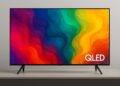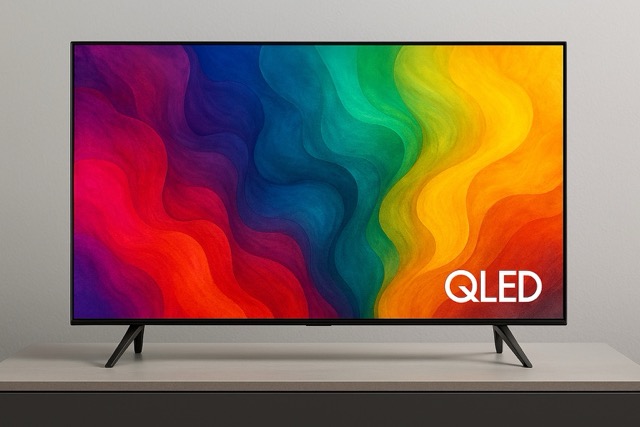
The 2025 Samsung Q7F delivers the colour pop and smart TV ease that most households want at a budget-friendly price, but its HDR brightness, black levels, and gaming features are limited. If you watch a lot of movies in a dimly lit room or want 120 Hz/VRR for gaming, consider stepping up a tier. If your priority is vivid colour, streaming apps, and simple setup under a tight budget, the Q7F hits a sweet spot.
“Q7F” doesn’t mean the same thing today as it did a few years ago.
The original Q7F (2017/2018) was a mid‑to‑high‑tier QLED with a premium design and connectivity (including the One Connect Box). The Q7F (2025) name was reused for a much more budget‑oriented QLED: a 60 Hz panel, no local dimming, and fewer HDMI ports. This guide clarifies those differences—so you buy the right Q7F for your needs.
Why we tested the Q7F—and what we looked for
We spent time with the 2025 Q7F in a mixed-use living space, where we enjoyed daytime streaming, evening movies with the lights dimmed, weekend sports, and casual gaming on a PS5/Xbox Series X. Our focus was real‑world usability: out‑of‑box picture, calibration gains, Tizen app workflow, and room placement. We also compared what we saw to the legacy 2017/18 Q7F models (still available used/refurbished), which featured more premium design touches.

- Display: 4K UHD (3840 X 2160 pixels) with Edge LED and Quantum HDR/HDR10+.
- Smart Tech: Tizen OS with Bixby/Alexa/Google Assistant and SmartThings.
- Gaming: AI Auto Game Mode, Motion Xcelerator, and Ultrawide GameView.
- Connectivity: 3x HDMI 2.0 (eARC), USB, Wi-Fi, and Bluetooth 5.3.
- Viewing: 178° wide viewing angle.


Display: 55" 4K UHD (3840 X 2160 pixels) with Edge LED and Quantum HDR/HDR10+.
Smart Tech: Tizen OS with Bixby/Alexa/Google Assistant and SmartThings.
Gaming: AI Auto Game Mode, Motion Xcelerator, and Ultrawide GameView.
Connectivity: 3x HDMI 2.0 (eARC), USB, Wi-Fi, and Bluetooth 5.3.
Viewing: Wide 178° viewing angle.
Why this matters
If you’re browsing retailer pages or reading reviews, you’ll see the Q7F (2025) praised for price but critiqued for limited HDR/gaming features, while legacy materials for the Q7F (2017/2018) highlight premium touches like Boundless 360° Design, No Gap Wall Mount, and One Connect cabling.
Knowing which generation you’re considering prevents disappointment and helps you match the TV to your room, habits, and budget.
Picture Quality: Color that pops, HDR that’s good—but not great
Out of the box, the first thing we noticed was color punch. Quantum Dot does what it says on the tin: reds and greens look lively, animated shows and nature docs feel saturated in a pleasing way. In Standard or Dynamic modes, you get instant “wow,” but we preferred Movie/Filmmaker mode for more natural skin tones and less aggressive processing.
Where the Q7F shows its price point is HDR on dark scenes. With no local dimming and modest peak brightness, small highlights don’t leap off the screen the way they do on higher‑tier QLED/Neo QLED sets. In a moderately lit room, HDR looks fine; in a dark room, you’ll see grayish blacks and less separation between shadow details. Still, for everyday streaming (Prime Video, Netflix, Disney+), it’s absolutely serviceable and enjoyable—just set expectations if your benchmark is cinema‑grade contrast.
Calibration tip: Switch to Filmmaker Mode, reduce Sharpness to near zero, keep Contrast Enhancer off, and set Color Tone to Warm 1. This tightened skin tones and reduced the “video” look without dulling the QLED color.
Motion & Sports: Fine for casual viewing, not for purists
At 60 Hz, fast pans and quick ball movement can smear. For football and F1, we found Auto Motion Plus on Custom (with judder reduction low) helped a bit without introducing soap‑opera effect. If your top priority is razor‑clean motion for sports, you’ll want a set with 120 Hz and better backlight control. If sports are part of varied viewing, the Q7F is still pleasant—just not reference‑class.
Gaming: Casual is fine; competitive gamers should look elsewhere
The Game Mode keeps input lag low enough for casual sessions, but the lack of HDMI 2.1, VRR, and 120 Hz is a hard limit. We played narrative titles and family party games without issue; competitive shooters felt less responsive compared to 120 Hz/VRR screens. If gaming is secondary, you’ll be okay. If gaming is primary, step up a tier.
Smart TV & Everyday Usability: Tizen is easy, fast, and family‑friendly
Tizen OS is intuitive: home screen recommendations are sensible, app switching is quick, and Samsung TV Plus gives instant free channels without logins. AirPlay support made it simple to cast from Apple devices; voice search via Bixby/Alexa helps the “what should we watch?” moments. Multi‑View is neat for keeping an eye on a game while browsing.
We appreciated the adjustable feet (quick to slot in), a slim look that suits modern furniture, and the all‑in‑one remote that doesn’t overwhelm guests.
Audio: Clear enough for dialogue; add a soundbar for impact
Built‑in speakers keep dialogue intelligible, which matters for news and talk-heavy shows. Music and movie soundtracks sound thin; explosions lack punch. If you care about audio immersion, pair it with a Dolby Digital soundbar over HDMI ARC. A basic bar elevates the experience dramatically.
Room Placement & Reflections: Mind the lighting
The glossy finish and moderate brightness mean strong daylight or lamps aimed at the screen can reduce perceived contrast. In our setup, angled lighting and a bias light behind the TV improved comfort and reduced perceived haze. If your room gets direct sun, consider a brighter model or heavier curtains.
Who should buy the Q7F (2025)—and who shouldn’t
Buy it if:
- You want vivid QLED color, modern apps, and a clean design at a budget price.
- Your viewing is mostly streaming, TV Plus, and casual gaming.
- Your room has some ambient light; you’re not building a pitch‑black home theatre.
Skip/Step up if:
You need four HDMI ports on the TV (the Q7F typically has three).
You want cinematic HDR with deep blacks for dark‑room movie nights.
You care about sports motion clarity or competitive gaming at 120 Hz/VRR.
Legacy Q7F (2017/18): quick comparison perspective
- Q7F (2017/2018) — Premium‑leaning QLED for its time: stronger HDR marketing (“Q | 4K Colour Drive Elite,” “Elite Black”), neat cable management via One Connect, 4 HDMI and 3 USB, and a design meant to look great wall‑mounted.
- Q7F (2025) — Value‑focused QLED: 60 Hz, no HDMI 2.1/VRR, 3 HDMI ports, and no local dimming. Delivers vivid QLED colour and modern Tizen features at a low price, but HDR and motion are modest. Available in 43″–98″ sizes.
Picture Quality, Features, and Real‑World Performance
Color & HDR
- 2017/2018 Q7F: Marketed to deliver deeper blacks and higher colour volume (“Elite Black,” “Colour Drive Elite”). While not an OLED and typically edge‑lit, it aimed for a brighter HDR experience in living rooms of the era.
- 2025 Q7F: Quantum Dot still brings vivid colour, but HDR brightness is limited; highlights don’t “pop,” and reflections can be an issue in bright rooms. Best in moderate lighting.
Motion & Gaming
- 2017/2018 Q7F: Sold with “Motion Rate 240” branding for smoother sports; connectivity aligned to HDMI 2.0/4K60 of the time.
- 2025 Q7F: 60 Hz native, no VRR, no HDMI 2.1—fine for casual console play, not for competitive or 120 Hz gaming. Input lag is acceptable, but motion blur appears in fast scenes.
Smart TV (Tizen) & Ease of Use
- Both generations utilise Tizen OS , which offers broad app support. The 2025 refresh adds Apple AirPlay, Samsung TV Plus, Multi‑View, and Voice Control in a simplified UI; setup is quick with adjustable feet.
Design & Connectivity
- 2017/2018: Boundless 360° Design, optional No Gap Wall Mount, One Connect Box for clean installs, 4 HDMI/3 USB—classic premium Samsung touches.
- 2025: Slim bezels, 3 HDMI (not 4), easy assembly, and a focus on value rather than cabling elegance. If you need 4 HDMI inputs, consider stepping up a tier or using a switch.
Side‑by‑Side Comparison (Quick Reference)
| Feature | Q7F (2017/2018) | Q7F (2025) |
|---|---|---|
| Lineup position | Mid‑to‑high tier QLED of its time | Entry‑level QLED (between Q6F and Q8F) |
| Panel & refresh | VA LCD; Samsung “Motion Rate 240” marketing (premium motion positioning for that era) | VA LCD; 60 Hz native, no VRR; motion blur in fast content |
| Local dimming | Typically edge‑lit; no full‑array local dimming | No local dimming (edge/direct‑lit) |
| HDR formats | HDR10, HLG (premium HDR branding for the time) | HDR10, HDR10+, HLG; no Dolby Vision |
| Brightness & highlights | Brighter than entry LCDs of the era; designed for living rooms (varies by size/region) | Dim in HDR; highlights don’t stand out; average reflection handling |
| Color | “Q | 4K Colour Drive Elite,” high colour volume messaging |
| Smart OS | Tizen; OneRemote; One Connect architecture; robust apps | Tizen with Samsung TV Plus, AirPlay, voice control; large app library |
| HDMI & ports | 4 HDMI, 3 USB, One Connect Box (tidy cabling) | 3 HDMI (no HDMI 2.1), USB; if you need 4 HDMI, consider alternatives |
| Sizes | 55″, 65″, 75″ | 43″, 50″, 55″, 65″, 75″, 85″, 98″ |
| Best for | Stylish wall mounts, tidy installs, brighter living rooms (for the time) | Budget QLED shoppers; everyday streaming; casual gaming |
| Not ideal for | Deep‑black home theaters vs. FALD/OLED | Demanding HDR, bright rooms with lots of glare, 120 Hz/VRR gaming |
Should you buy the Q7F in 2026?
- Choose the Q7F (2025) if you want QLED colour and modern Tizen at a low price, and your usage is mostly streaming, TV, and casual console play—with some ambient light in the room. Expect restrained HDR and motion.
- Consider a step‑up model (e.g., Q8F or a Neo QLED) if you need brighter HDR, local dimming, HDMI 2.1, or 120 Hz gaming features.

- If you find a well‑priced 2017/2018 Q7F used, you’ll get a higher‑tier design and connectivity for the era—but compare it carefully against modern sets for HDR and OS support before committing.