
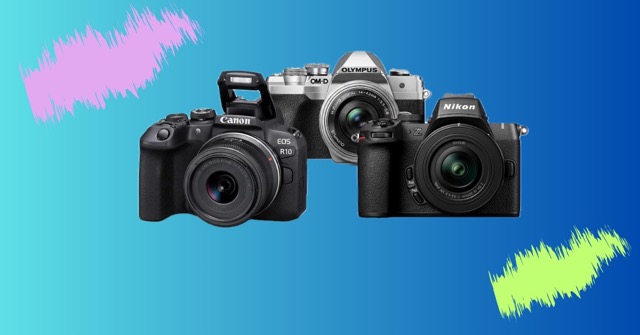
We recognise that transitioning from a smartphone to a dedicated interchangeable lens camera represents a significant, yet highly rewarding, step in one’s photographic journey. The contemporary landscape for entry-level models is robust, offering mirrorless systems that blend ease of use with the high-end features necessary for substantial skill progression.
Our comprehensive analysis focuses on the top-tier beginner cameras, evaluating their core strengths in image quality, advanced functionality, and the crucial capacity to grow with the user.
We concentrate on the leading mirrorless contenders—the Canon EOS R10, the Olympus OM-D E-M10 Mark IV, and the Nikon Z50 II—to deliver a definitive guide for your initial investment.
🥇 The Canon EOS R10 Mirrorless Digital Camera: A Powerhouse for Speed and Action Photography Enthusiast
The Canon EOS R10 has established itself as the benchmark for a modern, performance-focused beginner camera. We find its integration of Canon’s latest-generation technology—most notably the Digic X processor and advanced Dual Pixel CMOS AF II autofocus system—to be a critical differentiator in the entry-level segment.
This camera is fundamentally designed to handle fast-moving subjects with exceptional reliability, making it an outstanding choice for new photographers interested in action, sports, or wildlife. The autofocus includes intelligent subject tracking for humans, animals, and vehicles, a feature typically reserved for more professional bodies.

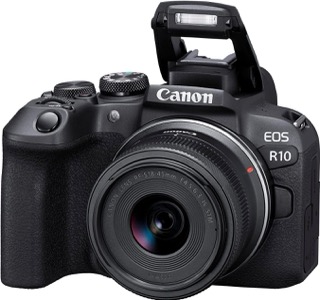
The compact and lightweight chassis, coupled with a well-defined ergonomic grip and an articulating touchscreen, ensures comfortable and intuitive handling even for novices. While its native RF-S lens lineup is still expanding, the ability to utilise the vast existing ecosystem of EF and EF-S lenses via an adapter provides substantial long-term flexibility.
We must acknowledge the absence of in-body image stabilisation (IBIS) and the crop applied to 4K/60p video recording, but its raw speed—delivering up to 15fps with the mechanical shutter and an impressive 23fps (or more on the R10 with electronic) with the electronic shutter—sets a performance standard that few rivals can match at this price point. The 24.2MP APS-C sensor produces sharp, vibrant still images with excellent dynamic range, offering ample latitude for editing in RAW format.
The Canon EOS R10 Specifications
| Specification | Detail | Beginner Value Proposition |
| Sensor Type | 24.2MP APS-C CMOS | High resolution for excellent detail and cropping flexibility. |
| Autofocus System | Dual Pixel CMOS AF II | Flagship-level subject detection for reliable focus on people, animals, and vehicles. |
| Max Burst Rate | Up to 23fps (electronic) | Essential for freezing peak action moments in sports or wildlife. |
| Processor | Digic X | Enables high-speed operation and advanced AF algorithms. |
| Video | 4K/30p uncropped, 4K/60p (cropped) | High-quality video capabilities for hybrid shooters. |
🥈 The Olympus OM-D E-M10 Mark IV Camera: Mastering Portability and Stability with IBIS
For the beginner prioritizing portability, effective stabilization, and an enormous selection of compact lenses, the Olympus OM-D E-M10 Mark IV is an exceptionally compelling choice. Built around the Micro Four Thirds (MFT) standard, this camera features a smaller sensor than its APS-C competitors, but expertly counters this with a critical advantage: 5-axis in-body image stabilization (IBIS).
This IBIS system is highly effective, allowing for significantly sharper handheld photos and smoother video, especially in challenging low-light scenarios where a slower shutter speed is required.

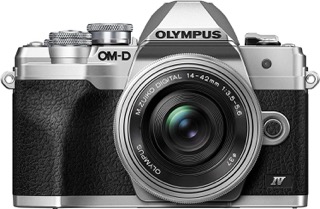
The camera’s classically styled shell and tactile control dials offer a satisfying and intuitive shooting experience, encouraging the user to engage with manual settings—a key aspect of skill development. The MFT system boasts an unrivalled legacy of lenses, offering beginners a compact, affordable path to building a highly versatile kit without the size and weight associated with larger formats.
We find the 20.3MP MFT sensor delivers rich, attractive JPEGs straight from the camera, renowned for their vibrant color science. While its contrast-detection autofocus is not as advanced as the phase-detection systems on the Canon R10 or Nikon Z50 II, its performance remains highly competent for general photography and portraiture. The flip-down touchscreen is particularly useful for low-angle work and selfies.
Olympus OM-D E-M10 Mark IV Specifications
| Specification | Detail | Beginner Value Proposition |
| Sensor Type & Size | Four Thirds CMOS (17.4 x 13mm) | The Compact Camera System is light and easy to carry, ideal for travel and beginners seeking portability. |
| Sensor Resolution | 20 MP / 20.2 MP | High enough resolution for excellent everyday photography. |
| Max Native ISO | 25,600 | Suitable light sensitivity for most common shooting conditions. |
| Rear Screen | 3.0″ Tilting screen with 1,040k dot resolution | Tilting screen is convenient for shooting from high or low angles. |
| Beginner Focus | User-friendly guided menus | Easy-to-Use Interface is highly recommended for those new to photography. |
| Lens Mount | Micro Four Thirds | Access to a wide and mature ecosystem of compact and relatively affordable lenses. |
🥉 The Nikon Z50 II Digital Camera: Ergonomics, Advanced Autofocus, and Future-Proofing
The Nikon Z50 II builds upon its predecessor, offering a potent combination of a deep, comfortable grip—excellent for first-time users—and a highly capable 20.9MP APS-C sensor. Its performance is driven by a powerful processor (often cited as an Expeed 7 class in current discussions), which unlocks robust subject detection and tracking autofocus capabilities that rival Nikon’s flagship professional models. This makes the Z50 II a reliable choice that beginners can confidently grow into.


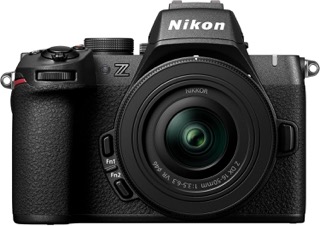
One of its primary strengths is its superior ergonomics; the camera feels substantial and secure in the hand, promoting stability. Its Z-mount system represents the future direction of Nikon, ensuring that any investment in Z-mount lenses is highly future-proof. While the Z-mount APS-C (DX) lens catalog is still maturing, the existing lenses are of a high optical standard. We appreciate the Z50 II’s well-implemented, articulated touchscreen and a high-resolution electronic viewfinder (EVF) that provides a clear, accurate preview of the final image.
The camera is also often noted for its subtle yet effective weather-sealing, offering a degree of protection not always found in entry-level systems. This combination of stellar handling, advanced focusing technology, and durable build quality makes the Z50 II an exceptionally balanced choice for the discerning beginner photographer.
The Nikon Z50 II Digital Camera Specifications
| Specification | Detail | Beginner Value Proposition |
| Sensor Type & Size | APS-C BSI-CMOS (23.5 x 15.7mm) | Larger Sensor Size than the E-M10 IV, generally offering better image quality and low-light performance. |
| Sensor Resolution | 21 MP / 20.7 MP | Slightly higher resolution for detailed images. |
| Max Native ISO | 51,200 (100% higher than E-M10 IV) | Higher Light Sensitivity is great for capturing images in challenging low-light situations. |
| Focus Points | 110 more focus points than E-M10 IV | More Autofocus Points provide greater coverage and accuracy, making it easier to acquire and track subjects. |
| Video Quality | 2x better video recording quality (main camera) | Superior Video Performance for content creators and hybrid shooters. |
| Rear Screen | 3.2″ Tilting screen with 1,040k dot resolution | Larger Screen for easier composition and review of photos and videos. |
| Lens Mount | Nikon Z | Access to the growing Nikon Z mirrorless lens ecosystem. |
📊 Comparative Analysis: Key Technical Differences for the Beginner
Final Verdict: Canon EOS R10 vs. Nikon Z50 II vs. Olympus OM-D E-M10 Mark IV
The Canon EOS R10, Nikon Z50 II, and Olympus OM-D E-M10 Mark IV each cater to a specific beginner profile.
The Canon EOS R10 is the technical powerhouse, featuring a 24.2MP APS-C sensor and excelling in speed (23 fps) and advanced video capabilities, including being the first to bring 4K/60p to a camera in its class.
The Nikon Z50 II offers a comparable 20.7MP APS-C sensor and is technically superior to the E-M10 IV in overall performance and image quality.
Finally, the Olympus OM-D E-M10 Mark IV is the ideal choice for the casual beginner prioritising portability; its Four Thirds sensor makes it ultra-compact, and while it has a smaller sensor, it has a longer battery life compared to the Z50 II.
| Camera | Verdict & Rationale |
| Canon EOS R10 | Best Performance Powerhouse. The Canon R10 is the superior all-around choice for beginners transitioning to intermediate skills. It features a higher-resolution (24.2MP) APS-C sensor, an excellent modern autofocus system, and a blistering maximum burst rate of 23 frames per second. It offers great value and handling for its price. |
| Nikon Z50 II | Best for Core Image Quality & Build. The Z50 II is a solid entry-level choice, competing closely with the R10. It boasts a high-resolution APS-C sensor (20.7MP) with larger individual pixels than the E-M10 IV, which generally contributes to better image quality, particularly in low-light conditions. Its strength lies in a reliable performance and robust feel. |
| Olympus OM-D E-M10 Mark IV | Best for Portability & Beginner-Friendly Use. The E-M10 IV is the top recommendation for a beginner mirrorless camera focused on ease of use and maximum portability. Its Four Thirds sensor allows for an ultra-compact system, and it has a significantly longer battery life in CIPA testing (360 shots vs. 250 shots for the Z50 II). |
Digital Camera FAQs
What makes a mirrorless camera good for a beginner?
Beginner mirrorless cameras are typically compact and lightweight, offer excellent image quality, and have intuitive controls and settings that are easy for novices to learn.
How do mirrorless cameras differ from DSLRs?
Mirrorless cameras do not use a mirror mechanism to reflect the image to an optical viewfinder, making them generally smaller and lighter than DSLRs. They often use an electronic viewfinder and are considered better for video capture.
What is the best entry-level mirrorless camera currently recommended?
Many experts consider the Canon EOS R10 to be one of the top choices, as it leads the charge for hobbyists and novice photographers in the entry-level mirrorless category
Besides price, what factors should a beginner consider when buying a camera?
When picking your first camera, you should factor in price, overall image quality, and whether the features align with your primary use (e.g., photography, video, or content creation).